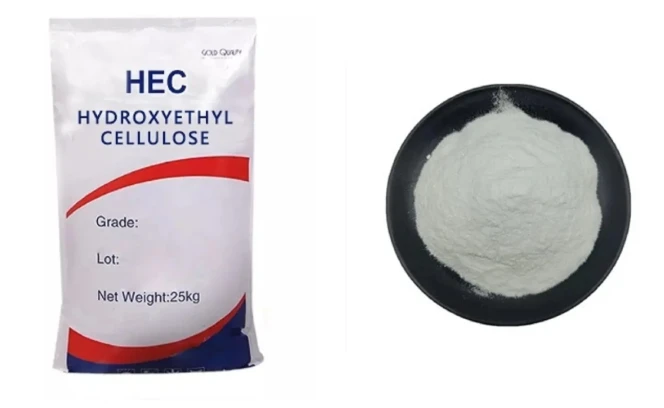
Thickening property
Hydroxyethyl cellulose (HEC) is an ideal thickener for coatings and cosmetics. In practical applications, its thickening property combined with suspension, safety, dispersibility and water retention will produce more ideal results.
Pseudoplasticity
Pseudoplasticity is the property that the viscosity of a solution decreases as the rotation speed increases. Latex paint containing HEC is easy to apply with a brush or roller and can increase the smoothness of the surface, which can also increase work efficiency; shampoo containing HEC has good fluidity and is very viscous, easy to dilute and easy to disperse.
Salt resistance
HEC is very stable in high-concentration salt solutions and will not decompose into ionic states. When used in electroplating, it can make the surface of the plated parts more complete and brighter. More noteworthy is that it still has good viscosity when used in latex paints containing borates, silicates and carbonates.
Film-forming property
HEC's film-forming property can be used in many industries. In papermaking, applying a glazing agent containing HEC can prevent the penetration of grease and can be used to prepare other solutions for papermaking; in the textile process, HEC can increase the elasticity of the fiber and reduce mechanical damage to it. In the sizing and dyeing process of fabrics, HEC can act as a temporary protective film. When its protection is not needed, it can be washed off the fiber with water.
Water retention
HEC is conducive to keeping the moisture of the system in an ideal state. Because a small amount of HEC in the aqueous solution can achieve a good water retention effect, the system reduces the water demand when mixing ingredients. Without water retention and adhesion, cement mortar will reduce its strength and adhesion, and clay will also reduce plasticity under a certain pressure.